A county fair pulling a few thousand people a day needs one toilet per roughly 50 to 75 attendees, mixed with at least one ADA unit per cluster under ADA Standards section 213.2. Westminster Porta Pros builds the count around your gate estimate, not a guess.
Start with attendance, then work backward. A fair expecting 3,000 people through the gate on a Saturday needs a different setup than a two-day event with 500 daily. Westminster Porta Pros sizes fair restrooms the same way OSHA sizes job sites: OSHA 1926.51(c) sets 1 toilet for 20 workers or fewer, scaling up from there, and that ratio logic is a reasonable starting point for public events too, layered with food vendor traffic and beer garden lines. Most fairs do best with a mix of standard portable toilets near parking and midway areas, plus a deluxe flushable unit or two near grandstands or VIP seating. If you are running a longer fair with paid entry, an event restroom package priced by the day makes more sense than piecing units together individually. Add handwashing near every food booth. 29 CFR 1910.141(d)(2) requires soap and towels or a hand-drying device at wash stations, not just sanitizer, so a proper handwashing station rental matters more than a bottle of gel on a table. For fairs with livestock barns or 4-H exhibits, treat those areas like farm and agricultural restrooms, since animal areas draw steady foot traffic all day and the units there see harder use than the midway units. Not sure what your gate count needs? Use how many porta potties do I need as a starting worksheet, then call to confirm.
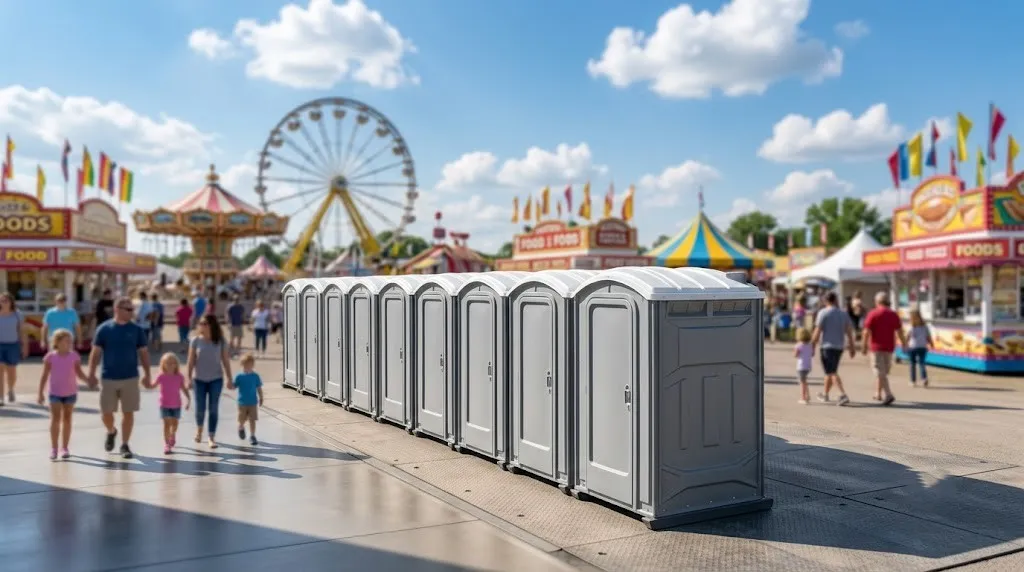
Fairs are not one crowd, they are several crowds stacked on top of each other: families with strollers, teenagers on the midway, vendors, and staff working twelve-hour days. A standard unit stands about 92 inches tall and sits roughly 44 by 48 inches on the ground, with a 60 to 70 gallon holding tank, which handles the bulk of general foot traffic fine. For anyone needing wheelchair access, ADA accessible units need a 60 inch turning circle inside per ADA Standards section 304.3.1, plus a 32 inch minimum door opening under ADA Standards section 404.2.3, so these are not the same box as a standard unit. If your fair has a beer garden or a ticketed grandstand area, a restroom trailer with real sinks and flush toilets reads a lot better to paying guests than a row of standard units, and a 4 stall restroom trailer handles moderate VIP traffic without a long wait. Bigger fairs sometimes bring in an 8 stall restroom trailer to cover the main grounds overnight when the midway runs late. Westminster sits close enough to draw fairgoers from Broomfield, about 5.6 miles north, and Federal Heights, 3.9 miles southeast, so plan restroom counts around the wider draw, not just city residents. Pair units with a temporary fence rental or crowd control barrier rental to keep restroom lines organized and away from ride queues.
Bad placement creates lines, and lines create complaints faster than almost anything else at a fair. Surfaces under and around units need to be stable and slip resistant per ADA Standards section 302.1, which rules out soft grass after rain or loose gravel near a midway entrance. Delivery trucks need clearance too. A roll-off or trailer delivery typically needs about 60 feet of straight clearance behind the truck, which matters if your fairgrounds route trucks through a narrow gate or past parked vendor trailers. Follow the porta potty placement guide for spacing rules of thumb, and check accessible routes stay at least 36 inches wide per ADA Standards section 403.5.1 with no obstacles like generator cords or fence posts crossing the path. Westminster event organizers should also plan trash and grease disposal alongside restrooms. Food vendors generate real volume fast, and a roll-off dumpster rental or grease trap pumping service keeps the grounds from turning into a mess by day two. If your fair runs into cold weather, review porta potty in winter for freeze prevention steps, since a frozen unit is worse than no unit at all. For multi-day fairs, service frequency matters more than unit count. Confirm with your vendor how often units get serviced, since the ANSI/PSAI Z4.3 baseline interval assumes far lighter traffic than a fair sees.
Book as soon as your date and attendance estimate are set, ideally 60 to 90 days out for larger fairs. Popular fair weekends compete with weddings and construction jobs for the same trailers and ADA units, so early booking protects your date and unit selection.
Yes. ADA Standards section 213.2 requires at least one accessible unit per cluster of portable toilets, no matter how small the event. A one-day neighborhood fair with two standard units still needs an accessible option nearby.
Yes, multi-day and weekend fair packages are common. Pricing shifts depending on duration, so check event restroom rental options rather than booking single daily units, since weekend and event rates are structured differently than one-off day rentals.
Restroom trailer weekend rates run higher than daily rates because of setup, cleaning and generator needs. Get a specific quote through restroom trailer rental cost based on stall count, since 2-stall, 4-stall and 8-stall trailers price differently.
Placement in a public right of way or on city-owned fairgrounds property needs confirming with Westminster directly. Check porta potty permit requirements before finalizing your site plan, since rules vary by venue and lot ownership.
Yes. Westminster Porta Pros delivers county fair restrooms across Westminster and the surrounding metro, with same-day and next-day drop-off available on most orders.
Pricing depends on the unit and how long you need it. See our cost breakdown and request a free quote for an exact figure.
Standard rentals include scheduled service — a pump-out, a clean, a restock and fresh deodorizer. Busy or hot-weather sites can be serviced more often.
Call now or request a free quote — clean units, on-time delivery, transparent pricing.