Flood, fire, wind damage or a burst main. When Westminster homes and businesses lose water or sewer service, Westminster Porta Pros can usually get a unit on site the same day for as little as 150 dollars, with standard units, holding tanks and handwashing stations staged for fast turnaround.
Same-day delivery is the goal, and most calls placed before mid-afternoon get a unit that day. Disaster response does not follow a normal rental calendar, so emergency porta potty rental requests get pulled ahead of standing weekly routes. A standard unit holds 60 to 70 gallons and needs no water hookup, which matters when a water main is the reason you called. We stage trucks out of Westminster and can reach Federal Heights in about 4 miles if a shelter or relief point needs coverage there too. Broomfield sits roughly 5.6 miles north and Northglenn about 7.4 miles northeast, so a multi-site disaster response across those cities does not add much drive time. If your water is out but your sewer line is intact, a portable sink rental or handwashing station rental can restore basic hygiene faster than waiting on utility repairs. Shelters and command posts with limited plumbing often need both toilets and a place to wash hands, and OSHA 1926.51(a)(1) requires an adequate supply of potable water at any staffed worksite, disaster response included. We treat that as the baseline even for volunteer-run relief points, not just paid crews.
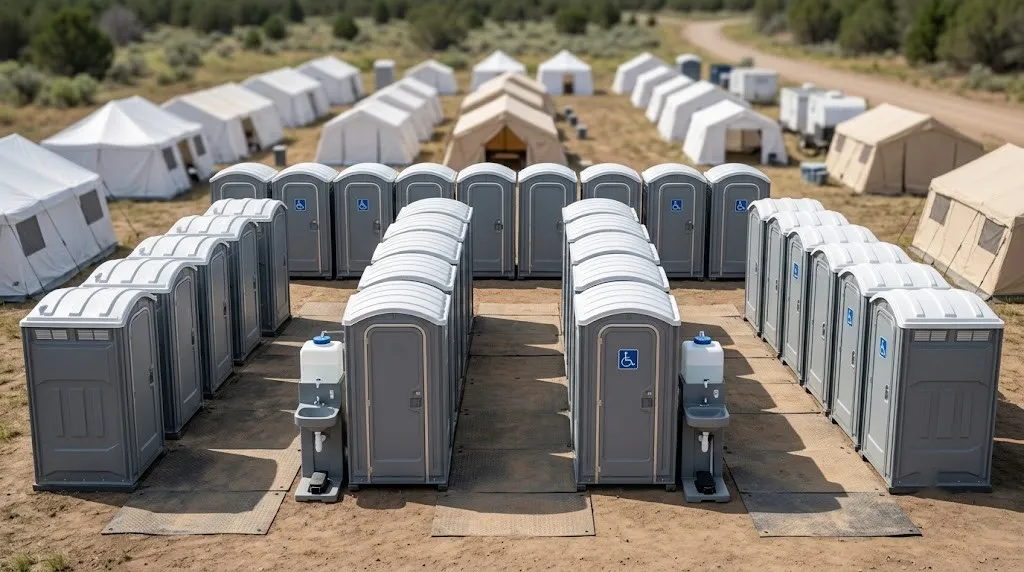
Toilets, holding tanks, handwashing stations and short-term storage, matched to how long the disaster response runs. A single flooded block might need two or three portable restroom rental units and a handwashing station near a debris pile. A larger event, like a multi-day power outage across Westminster, might call for a restroom trailer rental if a shelter needs something closer to a real bathroom. Our 8 stall restroom trailer can handle a crowded shelter site, while a 2 stall restroom trailer fits a smaller command post. If sewer lines are compromised, a holding tank rental keeps a building functioning without discharging into a broken system. For crews clearing debris, roll-off dumpster rental sizes range from a 10 yard dumpster rental for a single damaged home up to a 30 yard dumpster rental or 40 yard dumpster rental for block-level cleanup, though OSHA 1926.252 still governs how that debris gets loaded and disposed of. Accessible units matter here too. ADA Standards section 213.2 requires at least one accessible unit in any cluster, and disaster shelters are exactly the setting where someone using a wheelchair cannot wait. An ADA accessible porta potty has a 60 inch turning circle per ADA Standards section 304.3.1, which a standard unit's footprint does not allow.
Because a shelter or work crew that runs short on toilets creates its own health problem on top of the disaster. OSHA 1926.51(c)(1) sets a baseline of one toilet facility per 20 workers on a construction-style crew, scaling to one toilet seat and one urinal per 40 workers as headcount rises past 20. That standard was not written for emergency shelters, but it is the closest published ratio we have, and we use it as a starting point when a city department or relief coordinator asks how many units a site needs. Our how many porta potties do I need guide walks through the math for both crews and public gatherings. If contractors doing repair work are engaged in applying paints, coatings or other contaminants during rebuild, OSHA 1926.51(f)(1) requires washing facilities beyond a basic toilet, and 29 CFR 1910.141(d)2 specifies soap and towels or a hand-drying device, not sanitizer alone, for that washing setup. Servicing frequency also matters once a site is running. ANSI/PSAI Z4.3 sets a baseline of one service visit per week for up to 10 users over a standard 40-hour week, but a disaster site with heavier use needs more frequent stops, which we adjust once we see actual traffic. Wheat Ridge, about 11 miles south, and Lafayette, about 10.9 miles north, fall inside the range we can reach for a regional disaster response without a long delay.
| unit | duration | typical price |
|---|---|---|
| standard | day | 150 |
| standard | week | 200 |
| ada | day | 230 |
| dumpster | day | 75 |
| dumpster | week | 600 |
A standard unit typically runs 150 dollars a day, with weekly rates closer to 200 dollars if the response runs past a few days. Emergency deployment often carries a delivery fee on top, and our porta potty rental cost page breaks down what drives that number for shorter versus longer responses.
Yes. Shelters, command posts and volunteer staging areas get the same priority as active disaster sites. We size units around expected headcount, similar to how we plan for event restroom rental work, just on a faster timeline.
Often, yes, but a roll-off or trailer delivery needs about 60 feet of straight clearance behind the truck. Call ahead with road conditions so we can route around closures or damaged pavement before the truck leaves Westminster.
A hand sanitizer station rental or portable sink covers that gap. Sanitizer alone does not meet 29 CFR 1910.141(d)(2) for workplace washing, so pair it with a real handwashing station wherever crews are working, not just visiting.
As long as the response requires. Many disaster deployments start as a day rate and convert to a monthly porta potty rental once recovery work settles into a longer timeline, with no need to swap equipment.
Yes. Westminster Porta Pros delivers disaster relief sanitation across Westminster and the surrounding metro, with same-day and next-day drop-off available on most orders.
Pricing depends on the unit and how long you need it. See our cost breakdown and request a free quote for an exact figure.
Standard rentals include scheduled service — a pump-out, a clean, a restock and fresh deodorizer. Busy or hot-weather sites can be serviced more often.
Call now or request a free quote — clean units, on-time delivery, transparent pricing.